
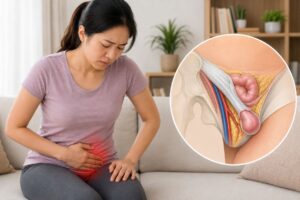
Hernias in Women: How Symptoms Can Differ from Men
Hernia symptoms in women can look quite different from the...
Disclaimer: The information in this article is intended to provide educational guidance as there may be other treatment options available; it does not replace the need for professional medical advice and should not be relied upon as specific advice for individual cases.

You’re lifting a box or coughing through a cold. Suddenly, there’s that sharp pull in your groin.
It stops you mid-motion. You pause, wondering if you just injured something or if it’s been there all along and you’re only now noticing.
Groin pain triggered by coughing or lifting isn’t random. It happens because these actions create sudden pressure inside your abdomen, and that pressure has to go somewhere. When it pushes against already-strained muscles, weakened tissue, or irritated nerves, you feel it.
The question is: what’s actually causing the pain, and when does it matter?
Your groin sits at the intersection of your lower abdomen and upper thigh. It’s packed with muscles, connective tissue, nerves, and the inguinal canal, a passage through your abdominal wall.
When you cough, your diaphragm contracts forcefully to expel air from your lungs. This creates a rapid increase in intra-abdominal pressure that surges downward toward your pelvis and groin.
When you lift something heavy, your core muscles brace to stabilize your spine. This bracing also increases abdominal pressure, pushing outward against your abdominal wall and downward into your groin area.
If there’s already a weak spot, a strained muscle, or an irritated nerve in that region, the pressure spike makes it worse. That’s why the pain appears precisely when you cough or lift, not during other activities.
Several conditions can produce groin pain when abdominal pressure increases. Here’s what you’re most likely dealing with:
A pulled groin muscle is the most straightforward explanation. It happens when you overstretch or tear muscle fibers in your inner thigh or lower abdomen.
You might have strained it during a workout, playing sports, or even just moving awkwardly while lifting something at home. The pain typically feels like a pulling sensation, and the area is tender to touch. Movement makes it worse.
Unlike a hernia, a muscle strain doesn’t produce a bulge. The pain is localized to the muscle itself.
An inguinal hernia occurs when abdominal contents push through a weak spot in your abdominal wall, usually near the inguinal canal. This creates a bulge you can often see or feel, especially when you cough or stand up.
Hernias cause a feeling of pressure or heaviness in your groin. The pain often worsens when you cough, lift, or bend over. Many hernias don’t cause pain, but symptomatic ones can produce burning, gurgling, or aching sensations.
Here’s what confuses people: sometimes a hernia is so subtle that there’s no visible or palpable bulge. Pain during pressure-increasing activities might be your only symptom.
Despite the name, this isn’t actually a hernia. It’s a strain or tear in the soft tissues of your lower abdomen or groin, common in athletes who perform sudden direction changes or intense twisting movements.
The pain is sharp and localized. It appears during activity and often improves with rest. Unlike an inguinal hernia, there’s no bulge.
In many cases, 4 to 6 weeks of physical therapy resolves the pain and allows return to activity. If pain returns when you resume sports, surgery may be necessary, with return-to-activity rates exceeding 80% regardless of surgical approach.
Nerves running through your groin can become compressed or irritated. This produces sharp, shooting pain that appears when you increase abdominal pressure.
The pain might radiate down your inner thigh or into your lower abdomen. It’s often described as electric or burning rather than a dull ache.
Problems with your hip joint, including labral tears or early arthritis, can refer pain to your groin. When you cough or lift, the sudden muscle contraction around your hip exacerbates the underlying joint problem.
This pain is typically deeper and more diffuse than a muscle strain. It might also appear when you rotate your hip or walk upstairs.
You might notice the pain is worse some days than others. This variability is normal and depends on several factors:
Your activity level matters. If you’ve been more active, lifting heavier objects, or exercising harder, you’re placing more stress on the affected area.
Your posture throughout the day influences pressure distribution. Prolonged sitting or standing in certain positions can aggravate groin discomfort.
Inflammation fluctuates. After you strain a muscle or irritate tissue, inflammation rises and falls based on how much you rest and how much you aggravate it.
This inconsistency makes it harder to determine if the problem is serious. You might think it’s improving, only to have it flare up again when you lift something or catch a cold.
Certain factors increase your likelihood of experiencing groin pain during coughing or lifting:
Chronic coughing creates repeated pressure spikes. Research shows chronic cough was identified in 38.6% of patients with inguinal hernia, as persistent coughing leads to increased intra-abdominal pressure.
Heavy lifting, whether at work or in the gym, stresses your abdominal wall and groin muscles. The same study found heavy lifting was reported by 63.6% of hernia patients.
Weak core muscles fail to properly support your abdominal wall, making hernias and strains more likely.
Previous injuries to your groin or abdomen create areas of weakness that are vulnerable to re-injury.
Age weakens connective tissue. Inguinal hernia prevalence rises significantly after 65.
Smoking impairs tissue healing and was reported by 62.0% of hernia patients in clinical studies.
Not every instance of groin pain requires immediate medical attention. But certain signs indicate you need professional evaluation:
⚠️ You notice a visible bulge in your groin or lower abdomen. This suggests a hernia that may require surgical repair.
⚠️ The pain is severe and accompanied by nausea or vomiting. This could indicate a strangulated hernia, where tissue becomes trapped and loses blood supply. A strangulated hernia is an emergency that can be life-threatening if not treated.
⚠️ The pain persists for more than a few weeks despite rest. Ongoing pain suggests an underlying structural problem that won’t resolve on its own.
⚠️ You can’t perform normal daily activities without discomfort. If the pain limits your movement or quality of life, evaluation is warranted.
⚠️ The pain is getting progressively worse. Worsening symptoms indicate the underlying problem is advancing.
⚠️ You have a fever along with groin pain. This could suggest infection or a more serious condition.
Ignoring groin pain that keeps returning doesn’t make it go away. It typically leads to one of these outcomes:
Reduced mobility. You start avoiding activities that trigger pain. This limits your exercise, work capacity, and daily function.
Compensatory strain. Your body adjusts movement patterns to protect the painful area. This places extra stress on your back, hips, and other leg, potentially creating new problems.
Progressive weakening. If you have a hernia, it typically enlarges over time. The opening in your abdominal wall gets bigger, making surgical repair more complex.
Risk of complications. Hernias can become incarcerated (trapped) or strangulated (blood supply cut off). These are surgical emergencies.
Early evaluation and treatment are simpler than dealing with advanced problems later.
Treatment depends entirely on what’s causing your pain:
For muscle strains: Rest, ice, compression, and anti-inflammatory medications typically resolve the problem within a few weeks. Physical therapy can help if the strain is severe or keeps recurring.
For inguinal hernias: Surgical repair is the definitive treatment. The likelihood of hernia recurrence after mesh repair is 1% to 3%, while without mesh, the recurrence rate is 5% to 8%.
For athletic pubalgia: Physical therapy is the first approach. Surgery is considered if conservative treatment fails and pain returns when you resume activity.
For nerve irritation: Treatment focuses on reducing compression and inflammation. This might include physical therapy, medications, or injections.
For hip joint problems: Treatment ranges from physical therapy and medications to surgical intervention, depending on the severity of the joint damage.
While you’re determining the cause of your groin pain, these adjustments can reduce symptom severity:
Improve your lifting technique. Bend at your knees, not your waist. Keep the object close to your body. Exhale as you lift rather than holding your breath.
Strengthen your core. Stronger abdominal and pelvic muscles better support your abdominal wall and reduce strain on your groin.
Address chronic coughing. If you have a persistent cough, treating the underlying cause reduces repeated pressure spikes.
Maintain a healthy weight. Excess weight increases abdominal pressure and strain on your groin area.
Avoid sudden, jerking movements. Smooth, controlled motions place less stress on vulnerable tissues.
Groin pain that appears specifically when you cough or lift tells you something about the underlying problem. It means pressure-sensitive structures are involved.
The pain isn’t random. It’s your body signaling that increased abdominal pressure is stressing an area that’s already compromised.
Most causes aren’t emergencies. But persistent or worsening pain deserves evaluation. The earlier you identify the problem, the simpler the treatment.
If you’re dealing with this issue, track when the pain appears, how severe it is, and whether you notice any bulging. This information helps medical professionals determine the cause more quickly.
The goal isn’t to diagnose yourself. It’s to recognise when professional evaluation is warranted and to understand what might be happening inside your body.
Groin pain during coughing or lifting is common. But common doesn’t mean you should ignore it if it persists.
No. While hernias are a common cause, especially in older adults, groin pain during coughing can also result from muscle strains, nerve irritation, or hip problems. The presence or absence of a visible bulge helps differentiate between causes.
If the cause is a minor muscle strain, yes. Rest and reduced activity often resolve the pain within a few weeks. However, if pain persists beyond this timeframe or keeps returning, evaluation is needed to identify structural problems that won’t self-resolve.
Not necessarily immediately, but if pain persists for more than a few weeks, worsens, or significantly limits your activities, evaluation is appropriate. Hernias can exist without visible bulges, and other causes of groin pain also require diagnosis.
A pulled groin causes pain and tenderness in the muscle itself, without a bulge. A hernia typically produces a visible or palpable bulge along with pain, though subtle hernias may only cause discomfort during pressure-increasing activities. Medical examination can definitively differentiate between them.
This depends on the cause and severity. Minor strains may improve with modified activity, while hernias and more serious injuries can worsen with continued stress. If pain increases during exercise or doesn’t improve with a few days of rest, stop the activity and seek evaluation.
Hernia symptoms in women can look quite different from the...

We're pleased to share that our very own Dr. Kan...

Discover when hernia is considered dangerous, the various hernia types...
Here at KYM Surgery, we believe in providing holistic & comprehensive medical care for all patients.
Here at KYM Surgery, we believe in providing holistic & comprehensive medical care for all patients.